

When You Know Something Is Off But Can't See It Yet
Century Custom | Red Deer, AB | Spring 2026
“I got to it at the start of the season instead of the middle of it, when there’s still room to move.”
— Steve, Owner, Century Custom
About the Organization
Century Custom is a residential renovation company based just outside Red Deer, Alberta. Owner Steve has operated the business for several years, building a reputation for quality finish work across kitchen, bathroom, and whole-home renovation projects. At the time of this engagement, the team consisted of five people: a lead carpenter with three years of tenure who carries day-to-day site coordination, a drywaller, a junior crew member, and two general labourers. Steve runs operations and remains hands-on across all active projects.
Spring is a transitional season for Century Custom. Project volume increases, client timelines compress, and the crew moves from the steadier rhythm of winter work into the higher-pressure pace of renovation season. The margin for disruption narrows.
The Situation
Heading into spring 2026, Steve felt broadly functional about his crew. Work was moving, nobody had quit, and the current renovation — a full-home reno with a hard client move-in date — was underway. On the surface, the operation looked stable.
Beneath that surface, Steve was carrying a set of concerns he had not yet acted on. His lead had been quieter than usual and shorter with the younger crew member. His drywaller had called in twice in a single month. A wage review was fourteen months overdue. And when Steve reflected on how well he actually understood what was happening with his people beneath the day-to-day surface, his honest self-score was three out of ten.
He wasn’t unaware that a gap existed. He was aware that he couldn’t see into it. That distinction is what the Workforce Condition Check is built for.
Steve completed the engagement in April 2026. All five employees completed the anonymous staff check-in. Motionwave produced the brief within five business days.
What the Scores Showed
The comparison between Steve’s self-scores and the aggregated staff scores surfaced a consistent pattern: the owner’s scores were lower than the staff average across all four sections, with the gap widest in Retention & Stability and Strain & Forward Confidence.

The direction of that gap matters as much as the numbers. Steve was carrying more concern than the staff aggregate reflected — not because his instincts were wrong, but because his direct awareness of specific individuals gave him a picture the aggregate could not fully capture. The brief treated that gap as information, not as a discrepancy to be resolved.
The most significant internal pattern in the staff data appeared between two scores that typically do not diverge. Commitment to showing up consistently scored 7.4 out of 10 across the team — among the strongest scores in the engagement. External settlement — how settled staff felt about things outside of work — averaged 4.2 out of 10, the lowest staff score in the entire check-in. The team intended to show up. Several were carrying weight that the surface picture did not show. That gap, left unaddressed, is a different kind of awareness than Steve had before the engagement.
“I got to it at the start of the season instead of the middle of it, when there’s still room to move.”
— Steve, Owner, Century Custom
What the Brief Gave Steve
Before the engagement, Steve’s decisions were made from instinct and surface observation — the only tools available to him. The brief did not replace those tools. It changed what he was deciding from.
Vague concern is one kind of input to a decision. Named, structured awareness of specific conditions is another. They can lead to the same decision — or they can lead to a different one. The brief cannot guarantee which. What it can do is extend the runway: the period between when a condition is forming and when it forces a response. For a small operator heading into a pressured season, that runway is often the difference between a decision made with options and a decision made without them.
A named dependency
Steve knew his lead was critical. The brief named the structural nature of that dependency clearly — the concentration of site coordination and institutional knowledge in one person represents an exposure that would not become visible until it became an operational problem. Naming it does not resolve it. But it moves the concern from instinct to a defined condition that can be held and watched deliberately.
A pattern, not a person
Steve had a quiet concern about his drywaller. The brief did not identify the drywaller — it identified a pattern in the aggregated staff data consistent with someone operating at reduced internal capacity while maintaining acceptable external output. Steve recognized the pattern. His instinct had a shape now that went beyond a feeling, and a shape can be monitored across time in a way a feeling cannot.
The gap between intention and capacity
The divergence between the team’s commitment scores and their external settlement scores was the most significant finding in the engagement. The staff intended to show up. The weight they were carrying outside of work was not yet visible in their output — but it was present in the data. Steve had suspected financial pressure was a factor. The brief gave that suspicion enough structure to hold as a reference point rather than set aside as speculation.
Two conversations already on his list
Steve had identified friction between his lead and his junior crew member, and had been deferring a conversation with his drywaller. The brief did not tell him anything he did not already know. It named both situations in a document, without judgment, which changed their status from things he was avoiding to things he was deliberately holding. That shift — from avoidance to structured awareness — is itself a change in decision posture, regardless of what follows.
The Questions the Brief Left Steve With
The brief closed with five reflection prompts calibrated to the specific patterns observed in this engagement. These are not action items. They are the questions a leader is better positioned to hold after a structured visibility engagement than before one.
Your lead is your highest operational dependency and has been quieter than usual. What would a low-pressure check-in with him look like — not a performance conversation, just a conversation?
You identified two conversations you have been putting off. Neither requires a defined outcome. What would it look like to simply open a door rather than have a formal conversation, and which one feels more pressing right now?
Staff scores around commitment to showing up were strong. Scores around wellbeing and external settlement were meaningfully lower. As the project deadline approaches, what would be the early signs that the gap between those two things is starting to close?
You noted that a wage review is fourteen months overdue. Regardless of what the outcome would be, what would it mean to the team to know it is on your radar?
You assigned your lowest score to awareness beneath the surface. Given the patterns in this engagement, what is the one thing you would most want to understand before the current project is complete?
Leader Visibility Index
The Leader Visibility Index is a four-question self-assessment completed twice: once before the brief is presented, and once four to six weeks after. It is not a performance evaluation. It measures how clearly the owner feels they are holding their team's condition, and whether that clarity shifts after seeing the engagement.
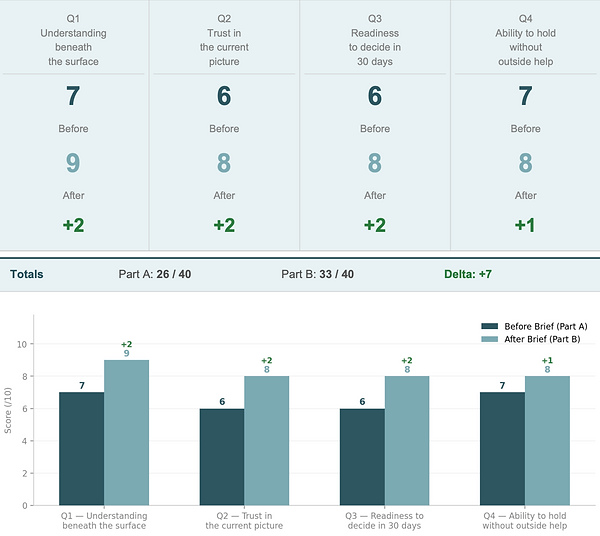
Across all four dimensions, Steve's clarity scores moved upward after seeing the brief. The strongest shifts appeared in Questions 1 and 3 — understanding what is happening beneath the surface, and readiness to decide within 30 days — both moving two points. Questions 2 and 4 each moved two points as well, reflecting a broad and consistent improvement across all dimensions of leadership clarity.
Steve entered the engagement already holding a reasonably grounded picture — his Part A scores averaged 6.5 out of 10, higher than is typical. The brief did not reveal conditions that were entirely invisible to him. What it gave him was structure: named conditions, a clearer shape for what he was carrying, and the specific questions that follow from that picture. The total delta of +7 reflects that shift — not a transformation of awareness, but a meaningful increase in the clarity with which he could hold what he already knew.
A Few Weeks Later
Several weeks after the brief was delivered, Motionwave followed up with Steve with two questions: how he was holding the engagement, and whether the runway the brief created had felt useful. His response is below.
"Honestly it’s hard to point to one thing and say that’s what changed. But I went into the back half of that project differently than I would have otherwise. I knew what I was watching for. With my lead — I just checked in. Nothing formal. Asked how he was doing with the workload. Turns out he’d been feeling like he was carrying more than I was seeing. We talked for maybe fifteen minutes. That’s probably a conversation I would have gotten to eventually but I’d have gotten there after something went sideways instead of before. The drywaller situation I’m still figuring out. I don’t have an answer there. But I’m not pretending I don’t see it anymore either. That’s different.”
— Steve, Owner, Century Custom — follow-up conversation, May 2026
What This Engagement Does and Does Not Do
The Workforce Condition Check is a single snapshot. It reflects conditions at one point in time, across one set of inputs, from one owner and one team. It does not establish a trend. It does not predict what will happen. It does not guarantee that the conditions it surfaces will remain as described in the weeks that follow.
No engagement of this kind is perfect. Participation levels, the honesty of inputs, the accuracy of the owner’s self-assessment, and the conditions present on the day of completion all affect what the brief can and cannot show. The brief names this explicitly. Signal confidence is only as strong as the inputs behind it.
What Steve had at the end of this engagement was a set of named conditions, a set of questions calibrated to those conditions, and a reference point he did not have before. What he does with those things is his.
This case study was produced by Motionwave Group Ltd. with the written consent of the client. Specific workforce findings have been included with explicit permission.
Motionwave Group Ltd. | www.workforceriskintelligence.com | Registered in British Columbia | PIPA-aligned